
Linen Napkins: A Beginner's Guide to Sizes, Folds and Everyday Use
A napkin is the one thing at the table that every guest touches before they touch anything else. It sits on a lap, mops up a spill, wipes a mouth, and somehow gets folded away at the end of the evening as if nothing happened. Linen does that job particularly well — but only if you buy a size that suits your table and fold it in a way you can actually reproduce on a Tuesday night.
Standard Sizes, and What They Are For
Napkin sizes are usually given as a square measurement, because most linen napkins are cut square. The size you want depends on the meal, the table, and how much lap you are expected to cover.
- Cocktail, 20–25 cm (8–10 in). Small squares for drinks, canapés and standing around. They are not for a seated dinner; they will not cover a lap.
- Luncheon, 35–40 cm (14–16 in). The everyday size. Good for breakfast, lunch, children, and smaller tables where a large napkin looks unwieldy.
- Dinner, 45–50 cm (18–20 in). The workhorse. A 50 cm napkin opens across the lap comfortably and still looks generous on the plate.
- Banquet or buffet, 55–60 cm (22–24 in). Big, relaxed, useful for buffets, garden lunches and anything involving a plate balanced on a knee.
A quick test in the shop: unfold a dinner napkin and lay it across your own lap. If the corners slide off your thighs when you sit, it is too small. If it reaches your knees in a stiff slab, it is too large for the way most people eat at home.
Linen, Cotton or Paper: Choosing Sensibly
Linen is woven from flax, and its character comes from that fibre: it absorbs quickly, dries faster than cotton, and has a slight irregularity in the weave that reads as relaxed rather than sloppy. It creases. That is not a fault to be fixed with heavy starch, though you can press it crisp if you prefer a formal table. Washing softens it year after year, which is why a well-used set of linen napkins often feels better than a new one.
Cotton is the practical alternative. It is generally cheaper, smoother, and more forgiving of a rough iron. It also feels slightly heavier in the hand and takes longer to dry. Linen-cotton blends sit between the two and are a sensible choice for a first set, especially if children will be using them.
Paper has its place, and it is not a compromise to admit it. Large messy gatherings, takeaways, anything with barbecue sauce: paper wins on cost and cleanup. What paper cannot do is stay on a lap, absorb a proper spill, or make a table feel considered. A useful rule is linen for guests, paper for crowd control, and a middle set of sturdy cotton for everything in between.
Folds Worth Learning
You need three folds, not thirty. Complicated standing folds look impressive in a photograph and are a nuisance to undo with one hand while holding a glass.
The flat rectangle
Fold the napkin in half, then in half again, or fold it in thirds. It lies flat on the plate, stacks neatly in a drawer, and looks tidy without any pressing. This is the fold to use most nights.
The triangle
Fold in half diagonally to make a triangle, then fold once more if the napkin is large. It sits well on a plate and looks slightly more deliberate than a rectangle. Freshly ironed linen holds the point nicely.
The roll in a ring
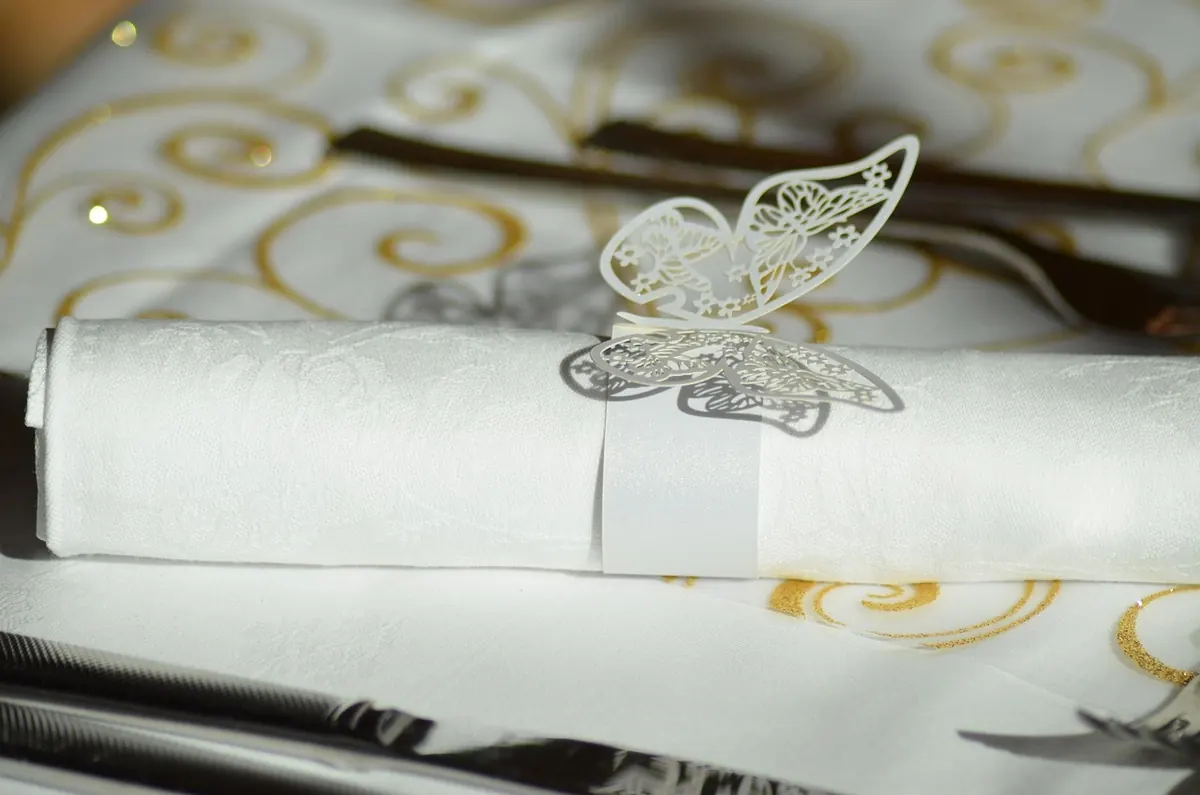
Fold the napkin in half, then roll it from the long edge into a cylinder and slide it through a napkin ring. Rolled napkins are excellent for buffets, and the ring can hold a fork and knife if you tuck them alongside.
The pocket fold, for cutlery
- Press the napkin into quarters so you have a square with the four open corners at the top.
- Turn the top layer down about a third of the way, leaving a visible band.
- Fold the left and right sides inwards so they meet in the middle, creating a pocket.
- Slide the cutlery into the pocket, blade and tines pointing up.
If you are folding for a large dinner and your hands are tired, remember that a slightly imperfect flat fold reads better than a fussy construction that nobody can open. Guests should be able to pick up a napkin with one hand and shake it out in one movement.
Laying the Table
For a standard place setting, the napkin goes to the left of the forks, or on the plate if space is tight. Place it so the open edges face the guest, which lets it unfold outwards into the lap rather than dragging across the table. In a water glass it will only work if the napkin is small and lightly rolled; anything larger looks strained and tends to topple the glass.
At the table itself, napkins belong on the lap, unfolded to a single thickness or left folded in half. Elaborate folds should be undone quietly as soon as you sit. When you leave the table mid-meal, place the napkin loosely to the left of your plate, not on the chair. At the end, gather it loosely beside the plate — no need to refold it into art.
Washing, Ironing and Storing Without Fuss
Shake crumbs out before the napkins go in the basket, and do not screw them into tight balls. Soak stained napkins in cool water as soon as you can; hot water can set a red wine or berry mark, and grease responds better to a drop of washing-up liquid worked in gently before a normal wash. Wash whites and lights warm, colours cooler, and skip fabric softener — it coats the flax fibres and reduces the absorbency that makes linen worth buying.
Dry on a line if you can, or tumble on low and take the napkins out slightly damp. Iron them in that state with a hot iron, on the reverse for the first pass if there is any embroidery. Linen can take real heat; what it does not like is being ironed bone dry. Store flat in a stack or rolled in a drawer, and rotate your sets so no single batch takes all the wear.
Building a Small Collection
Start with six dinner napkins at around 50 cm in one colour — natural, oatmeal, a soft mid-blue or a deep grey all hide everyday marks better than stark white. Add four luncheon napkins at 40 cm for breakfast and casual lunches, and keep a pack of good paper napkins in the cupboard for the evenings when nobody wants to think about laundry. Buy the best linen you can afford once, wash it without ceremony, and it will outlast most of the other things on your table.
Photo: NadineDoerle / Pixabay